Type of event
Invited Lecture
Date
2025-06-10
Location
9th Bi-City Biennale of Urbanism\Architecture, Shenzhen, China
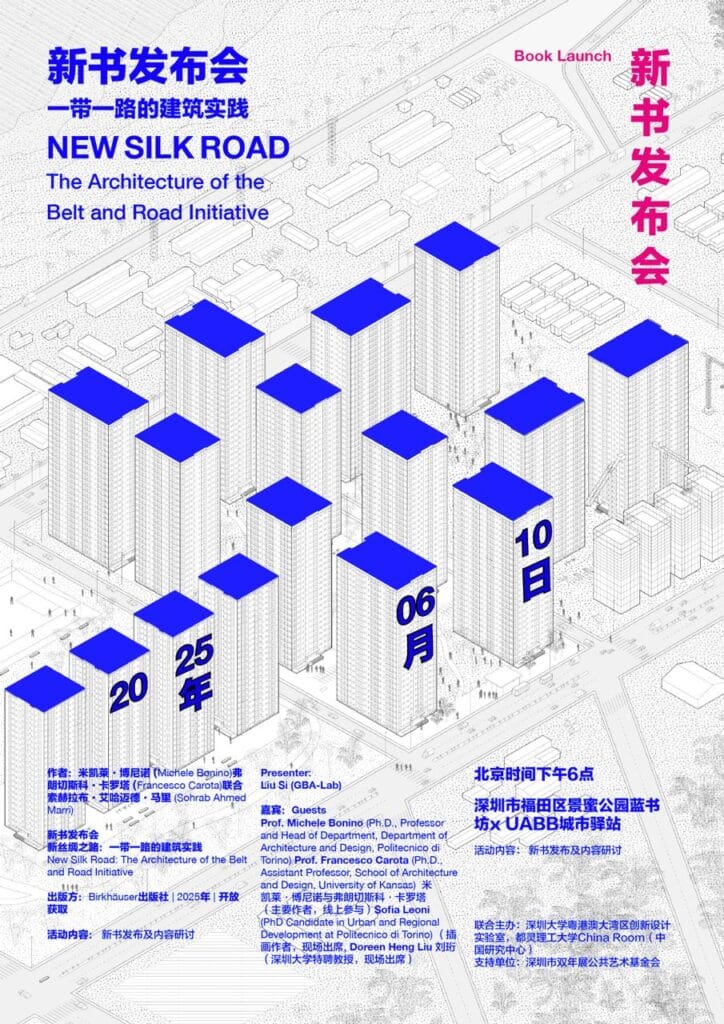
As part of a series of presentations I gave in the Spring of 2025, this lecture for the 9th Bi-City Biennale of Urbanism\Architecture examined the architectural and territorial dimensions of the Belt and Road Initiative (BRI) as one of the most extensive geopolitical and infrastructural undertakings of the twenty-first century. The talk, based on the recent publication “New Silk Road” (Birkhauser, 2025) addressed how the BRI operates not only as an economic and logistical network but also as a cultural and spatial project that redefines modes of production, mobility, and exchange across Asia, Africa, and Europe. Through a series of comparative case studies, it analyzed the emergence of new urban typologies—such as industrial parks, special economic zones, and cross-border cities—that articulate the intersection between state planning, global capital, and local material practices. The lecture proposed a critical framework for understanding the BRI as a site of architectural inquiry, where questions of sovereignty, ecology, and representation converge. It explored how design can reveal and reconfigure the plural agencies embedded in these vast infrastructural landscapes, emphasizing the need for situated and multi-scalar approaches to global urbanization. By engaging with the broader curatorial theme of the Biennale, the presentation positioned architecture as both a diagnostic and projective tool—capable of mapping the spatial consequences of global integration while envisioning alternative forms of connectivity, collaboration, and cultural exchange along the renewed “Silk Road” networks.