Type of event
Conference Presentation
Date
2017-02-03
Location
ENSA Paris-Belleville, Paris
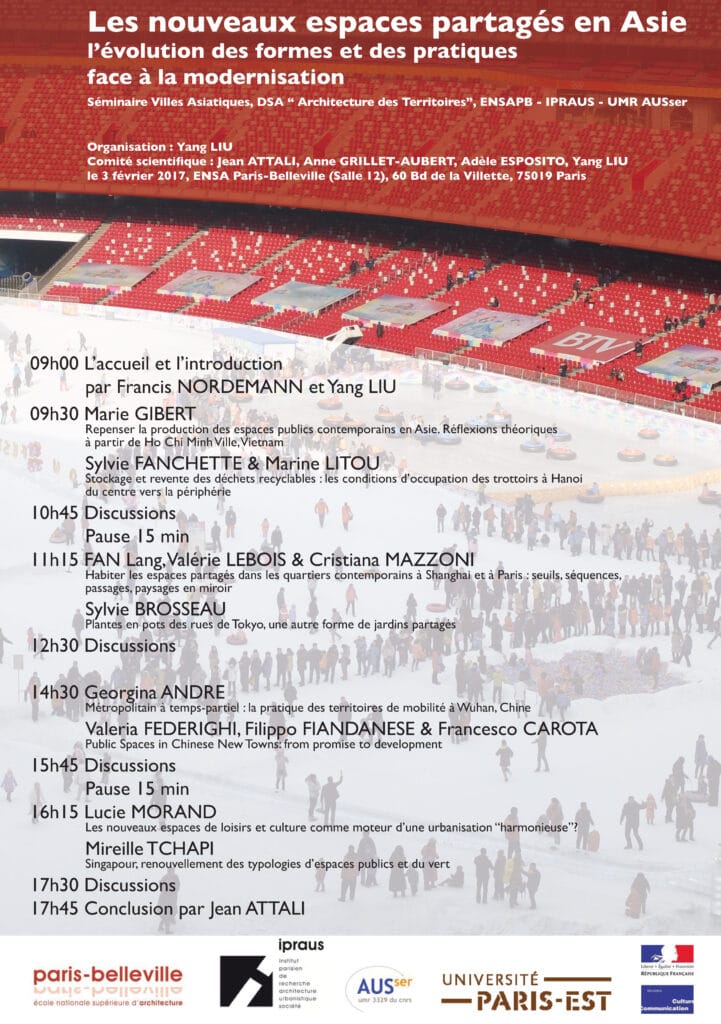
Urbanization in China is often presented to future residents as the promise of a new urban condition—the attainable dream of a better life—particularly where it is planned through large-scale developments, such as in new towns. Shared spaces are used to represent this ambition; they thus become commercial instruments that sell the prospect of a happier future. Developers and planners put forward images of an improved quality of life that convey new forms of social behavior. As a result, both the semi-private spaces of gated communities and the public spaces of cities acquire a commercial character, becoming a “brand.” To facilitate this process of marketization, these spaces are often designed as themed environments. In this way, urban residents can experience and consume a ready-made atmosphere, such as the English-style streets of Thames Town in Songjiang, eco-cities overrun with vegetation, or reproductions of traditional Chinese styles in Tongzhou and Zhengzhou. The aim of this contribution is to illustrate the rhetoric employed in these themed shared spaces for the construction of an urban promise, and their influence on the idea of quality of life offered to the Chinese middle class. Furthermore, it seeks to understand who the main actors involved are—the authors of this new urban vision—and how these urban and landscape design solutions are able to “produce quality” in response to the expectations of future consumers. Thanks to the opportunities offered by the international research project Chinese New Towns: Negotiating Citizenship and Physical Form, in which the authors participate, the analysis will be conducted through empirical fieldwork. The primary source will be space itself, in its physical form. In addition, the investigation will draw on promotional materials (brochures, renderings, newspapers, advertisements, “house books” (loushu), etc.) and interviews with local actors involved in the process.